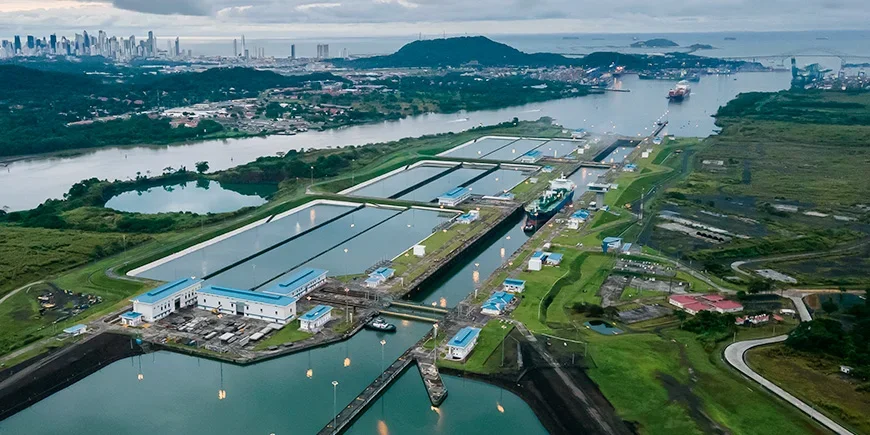
Few places in the world have had such a profound impact on global trade as the Panama Canal.
This maritime highway, winding through Panama’s stunning landscapes and linking two oceans, is not a product of nature but one of humankind’s most extraordinary engineering achievements.
Standing by the Panama Canal and watching a container ship being raised through its locks is a truly memorable experience. Here, nature, engineering, and world history come together in a way that feels almost tangible.
Join us as we explore the story behind this iconic engineering marvel, which you can discover for yourself on a tour to Panama with us.
What is the Panama Canal?
The Panama Canal is a man-made lock canal stretching across Panama, connecting two of the world’s great oceans: the Atlantic and the Pacific.
Before the shortcut through Panama was built, ships had to sail all the way around South America to travel from one ocean to the other – a journey that was not only time-consuming but also often dangerous. The Panama Canal therefore plays a crucial role in global trade, shortening sea routes by thousands of kilometres and making international shipping faster and more efficient.
Stretching 82 kilometres in length, up to 300 metres in width, and averaging 13 metres in depth, the excavation of the Panama Canal was an extraordinary achievement. It is still considered one of the most impressive engineering projects in the world – and it’s no surprise that today, the canal is among Panama’s most remarkable attractions.
How does the Panama Canal work?
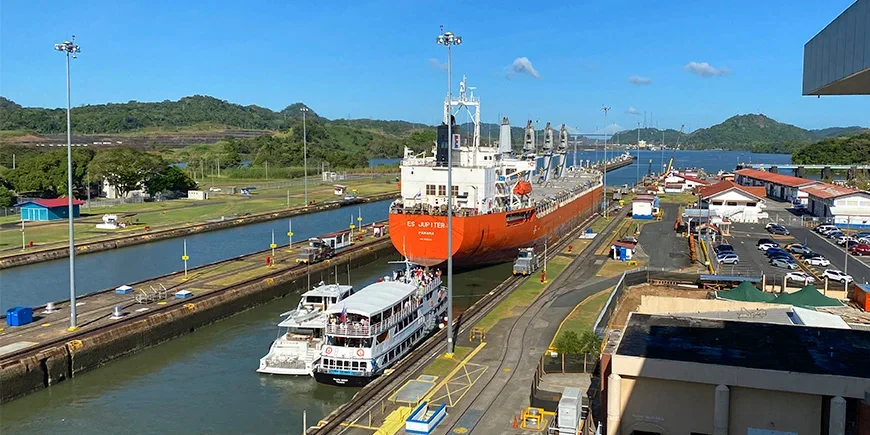
The Panama Canal operates through a system of locks that raise and lower ships as they pass through. Since digging all the way down to sea level would have been far too difficult and time-consuming, the canal was constructed several metres above sea level. As a result, ships cannot sail straight through without assistance.
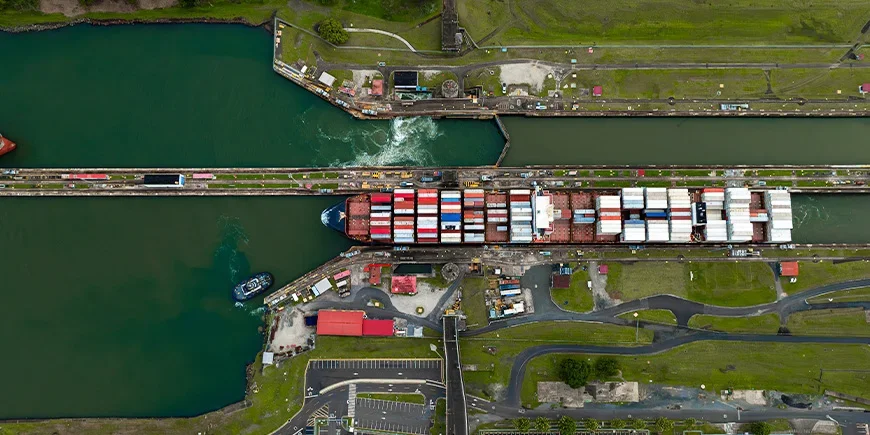
When a ship arrives at the Panama Canal, it first enters a large lock chamber. The gates close behind it, and the chamber fills with enormous volumes of water. As the water level rises, the ship is lifted to a height that allows it to continue along the canal and across the elevated Gatún Lake, which makes up a large portion of the Panama Canal.
After completing the 82-kilometre journey and reaching the other side of the canal, the process is reversed. The ship enters another lock chamber, where the water is gradually released, lowering the ship gently back down to sea level.
The lock system of the Panama Canal consists of three sets of locks: the Gatún Locks on the Atlantic side, and the Pedro Miguel and Miraflores Locks on the Pacific side. Together, these enormous water elevators enable more than 13,000 ships each year to take the shortcut between the two great oceans.
When was the Panama Canal built?
The Panama Canal was completed in 1914 – a project that took more than 30 years to finish.
The idea of digging a canal across Panama first arose in the early 1500s when Spanish colonists arrived in the area. After surveying the distance, they concluded that such an engineering feat would be impossible, and the idea was abandoned.
By the late 19th century, the French revived the idea and began excavating the Panama Canal in 1881. The work was led by Ferdinand de Lesseps, the man who had successfully overseen the construction of the Suez Canal in Egypt a few years earlier. However, building the Panama Canal turned out to be far more demanding than expected, and by 1889, funds had run out and the project came to a halt.
In the end, it turned out to be the United States that completed the project. The US had a strong interest in the Panama Canal and obtained permission from Panama in 1903 to finish its construction. After extensive excavation work, the Panama Canal was finally ready for use in 1914.
Since the inauguration of the Panama Canal, it has undergone continuous expansion – most recently in 2016, when a new lock system was opened, allowing even larger ships to pass through the canal.
Who owns the Panama Canal?
Today, the Panama Canal is owned and operated by Panama – though this has not always been the case.
After completing the construction, the United States managed the operation of the Panama Canal until 1977, when an agreement was made to gradually hand over control to Panama. Following a transitional period of joint administration – marked by tension and conflict – Panama assumed full control of the canal in 1999.
However, the story between the United States and the Panama Canal doesn’t end there. This is partly because the US, as the canal’s largest customer, pays substantial transit fees to pass through. As a result, American interest in the canal’s ownership and strategic importance has persisted.
How to experience the Panama Canal with TourCompass
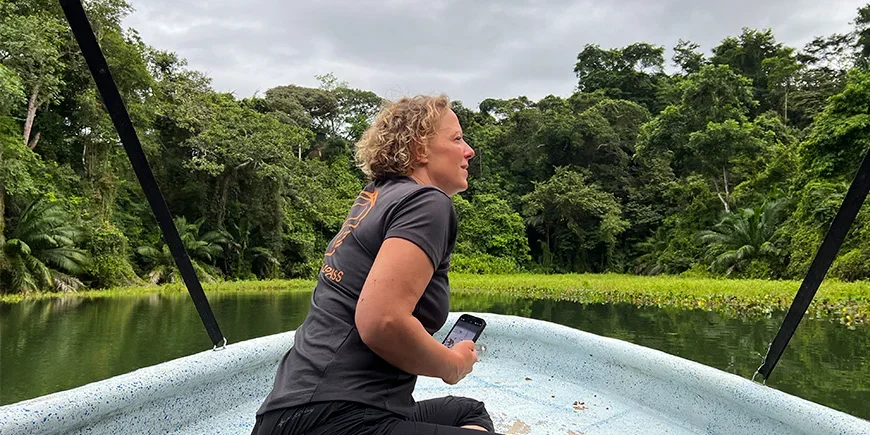
At TourCompass, we offer you the chance to experience the Panama Canal in several different ways.
From the viewing platforms at the Miraflores locks in Panama City, you can watch the massive container ships slowly make their way through the locks – an impressive spectacle where it feels as though the whole world is gliding past before your eyes.
You can also experience the iconic lock systems from the water on weekends with one of our optional tours. This boat trip through the Panama Canal takes you past the Miraflores and Pedro Miguel locks, through the dramatic landscapes of the Culebra Cut, and out onto Gatún Lake. Along the way, you may even spot crocodiles before the journey ends in Gamboa.
If you want to experience the Panama Canal surrounded by more scenic nature, you can also purchase an optional boat trip on Gatún Lake, which makes up a large part of the canal. From the boat, you might be lucky enough to spot monkeys and other wildlife living in the lush jungle along the canal’s banks – and you can also get a close-up view of the enormous cargo ships as they pass through this maritime highway.
No matter how you choose to experience the Panama Canal, a truly magnificent experience awaits.
Facts about the Panama Canal – summary
|
What is the Panama Canal?
|
The Panama Canal is a man-made lock canal that connects the Atlantic and Pacific Oceans.
|
|
Where is the Panama Canal located?
|
The Panama Canal is located in Panama.
|
|
How long is the Panama Canal?
|
The Panama Canal is 82 kilometres long.
|
|
How wide is the Panama Canal?
|
The Panama Canal is up to 300 metres wide.
|
|
How does the Panama Canal work?
|
The Panama Canal operates through a system of locks that raise ships up to the elevated canal and lower them again once they have crossed it. These lock systems work quite like gigantic water lifts.
|
|
When was the Panama Canal constructed?
|
The Panama Canal was completed in 1914, but the excavation work had already begun in 1881.
|
|
Who built the Panama Canal?
|
The Panama Canal was completed by the United States, although it was originally the French who began the construction work.
|
|
Who operates the Panama Canal?
|
Today, the Panama Canal is run by Panama, although it remained under American control for many years.
|
Would you like to experience the Panama Canal?
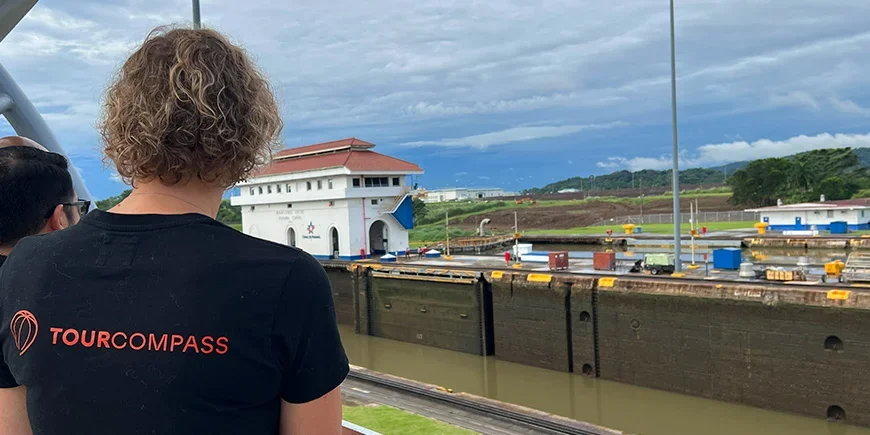
The Panama Canal is a fascinating encounter between nature and human ingenuity that leaves a lasting impression on every visitor. Would you like to witness with your own eyes the maritime highway that changed the world? Check out our tour to Panama and let us help you turn your travel dream into a reality.
TourCompass – From tourist to traveller
Check out our tour to Panama here