
The ugly birds – the shoebill
31/03/2026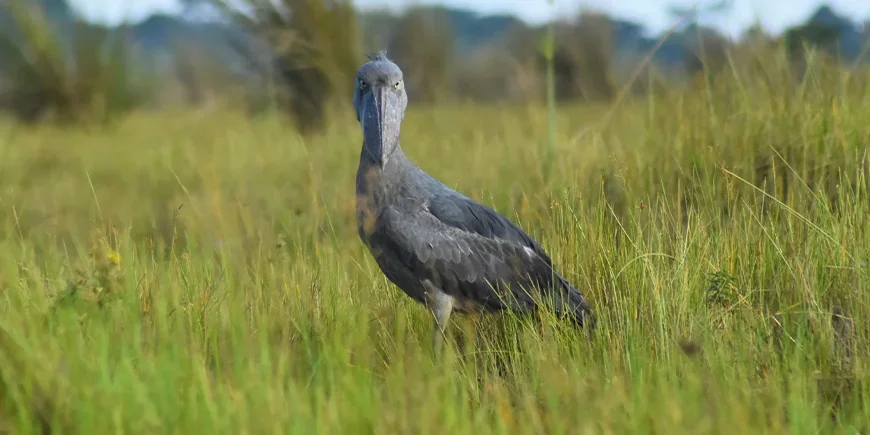
You’re gliding along a calm river surrounded by Uganda’s lush wilderness.
The air is heavy, and everything feels still – until you see it.
A bird with an unflinching stare.
A beak that looks like it belongs to another era entirely.
And a calm so unwavering it’s almost… eerie.
In part 1 of our series on the ugly birds, we met the vulture – misunderstood, yet fascinating.
Now it’s time for part 2.
This time, we turn our binoculars towards the shoebill – Africa’s living fossil.
Africa’s living fossil
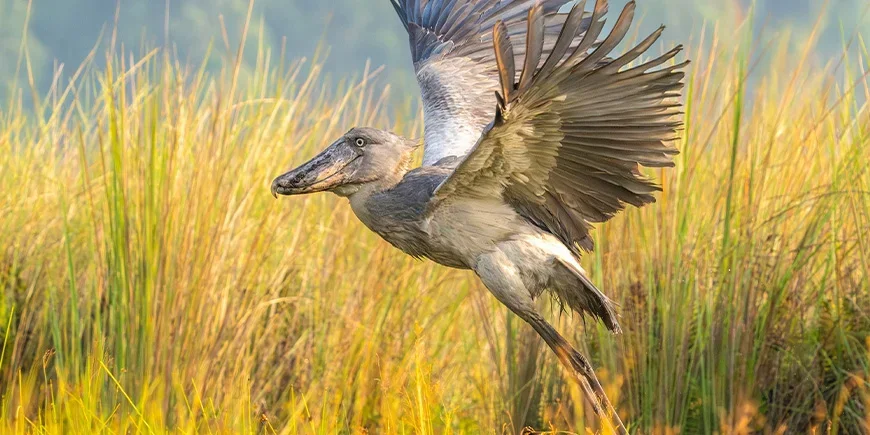
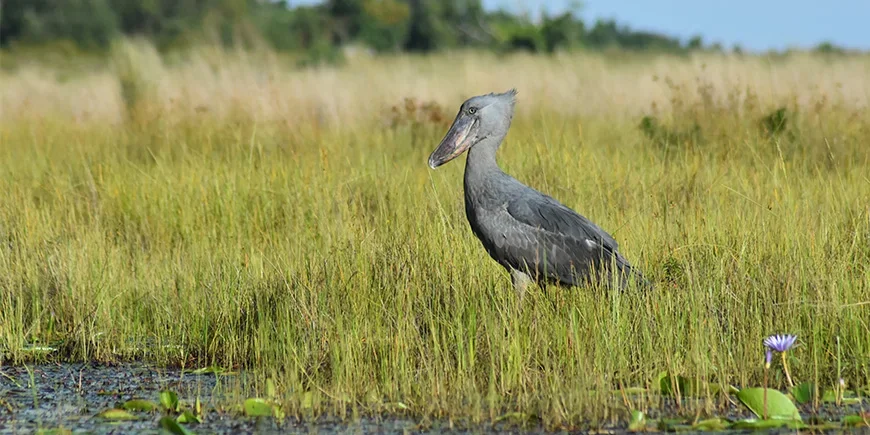
The shoebill (Balaeniceps rex) is one of Africa’s most extraordinary birds, and the first time you set eyes on it, your natural instinct will probably be to take a step back.
With a gaze so piercing that you might think it’s plotting its next move, the bird looks rather eerie. And that unsettling feeling only grows when you realise the shoebill can reach a height of up to 1.5 metres and has a head that could easily be mistaken for that of a dinosaur.
It’s no coincidence that it brings prehistoric giants to mind. Like all other birds, the shoebill is descended from dinosaurs, but unlike most of its relatives, it has retained its ancient features – earning it the nickname of a ‘living fossil’. This is one of the reasons why it’s included on the TourCompass’ Funny Seven list.
If you’re lucky enough to spot a shoebill, there’s no need to worry. Despite looking as if it has stepped straight out of Jurassic Park, it isn’t known to be aggressive towards humans. In fact, it’s something of a loner that prefers to keep a respectable distance from its own kind.
The truth is that very little is actually known about the shoebill, as it keeps to itself and usually lives in remote areas – and that’s perhaps why this bird often flies under the radar.
From patient waiting to sudden lightning strike: the shoebill’s hunting technique
It’s not just the appearance of the shoebill that makes it such a remarkable bird. It is also an exceptional hunter.
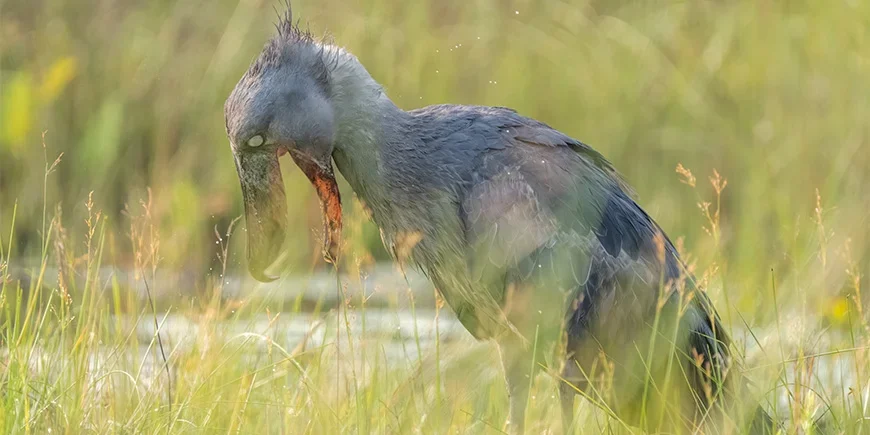
A true master of patience, the shoebill can stand completely still for hours, waiting for an unsuspecting victim – perhaps a fish, a water snake, or even a baby crocodile – to drift too close. More often than not, the prey doesn’t even notice the motionless bird before it suddenly lunges forward to strike.
This hunting method, often referred to as a “collapse”, can be extremely intense – and it’s a good thing the shoebill has its distinctive beak and thick skull. Together, they act like a built-in bicycle helmet, protecting the bird from injury.
Is the shoebill endangered?
Yes, in 2018 the shoebill was classified as an endangered bird species by the International Union for Conservation of Nature (IUCN).
Today, there are only between 3,300 and 5,300 individuals left worldwide. The population decline is mainly due to the destruction of their natural habitats, as swamps and wetlands are converted into farmland and grazing areas for livestock.
In some parts of Africa, these birds are also hunted, either for food or to be sold to zoos where they are highly sought after. In Uganda, for example, fishermen sometimes kill shoebills due to an old superstition that seeing one before going out to fish is a bad omen for the day’s catch.
Fortunately, several organisations are fighting for the shoebill – for instance, the conservation initiative Save Shoebill Conservation Project helps protect the species by monitoring and preserving its habitats, as well as by educating and supporting local communities in places such as Uganda, where people have a direct influence on the shoebill’s survival.
Can you spot the shoebill on safari with TourCompass?
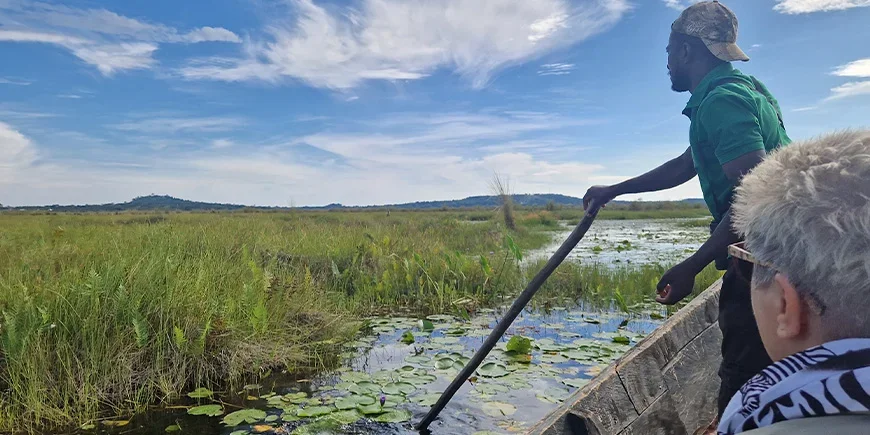
Yes, you might be lucky enough to see the shoebill when you go on safari with us.
The shoebill is endemic to the swamps and wetlands of Central and East Africa, and you might be fortunate to encounter it in Murchison Falls on a tour to Uganda.
If you want to increase your chances of spotting this unique bird, you’ll need to stay extra alert – the shoebill can remain completely still for hours on end. Until it suddenly lunges forward to snatch its prey, it can be rather tricky to spot.
Fancy seeing Africa’s ugliest bird?
The shoebill isn’t beautiful in the traditional sense of the word.
But that’s precisely the point.
Nature hasn’t only created what’s elegant or photogenic.
It has also created what’s strange, raw, and utterly unforgettable.
So next time you’re on safari, look out for the vulture. Look out for the shoebill. Look out for all the other so-called “ugly” birds. Because it’s often here that the most fascinating experiences are waiting to be discovered.
TourCompass – From tourist to traveller